
IES Learner Mode

Foundation · All engineering disciplines

Fault-Finding Fundamentals

Move from symptom to evidence, isolate a credible fault area and choose the next best test, without guessing or replacing parts at random.

45 minutes5 learning modules6 knowledge checksVisual and text alternatives

The diagnostic mindset

Do not ask “what can I replace?” Ask “what does the evidence eliminate?”

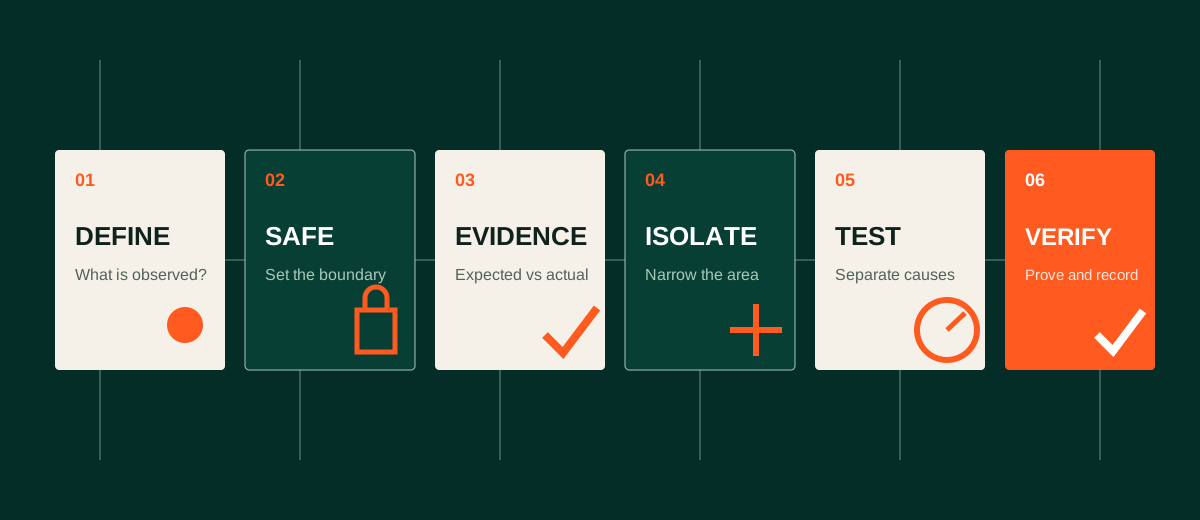
Six-stage fault-finding cycle: define, make safe, gather evidence, isolate, test and verify
Module 016 min

Symptom is not cause

A symptom is the evidence that brought the problem to attention. A fault is the condition preventing correct operation. A cause explains why that fault occurred.

01SymptomConveyor will not start→02FaultStart permissive is absent→03CauseGuard sensor is misaligned

Replacing the motor because “it will not start” jumps from symptom to solution without evidence.
Check your thinking

Which statement is a symptom?

Scenario challenge

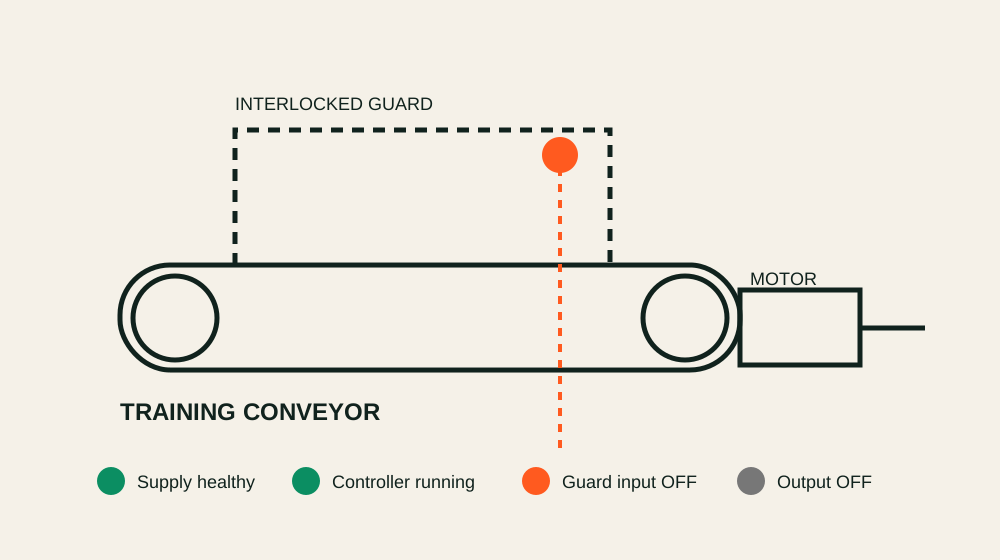
A guarded training conveyor will not start.

The supply indicator is on. The controller is running. The stop circuit shows healthy. The motor output is off. One guard-permissive input is also off.

Simplified training conveyor showing healthy supply and controller, with guard input and motor output off

Which is the best next action?

Transfer the method

Use the same thinking across engineering.

01MechanicalA pump vibrates after maintenance.02ElectricalA control circuit will not energise.03AutomotiveA warning lamp appears intermittently.04AerospaceA system fails a functional test.05ManufacturingA machined feature drifts outside tolerance.06DigitalA sensor value is present but implausible.

For lecturers and trainers

Use this before equipment-specific diagnosis.

Ask learners to build a fault tree, predict evidence and justify the next test. Then move into a supervised system where expected states, safe boundaries and technical information are known.

Record this in CPD →